By Doyle Bloss
What Is Filtration Soiling?
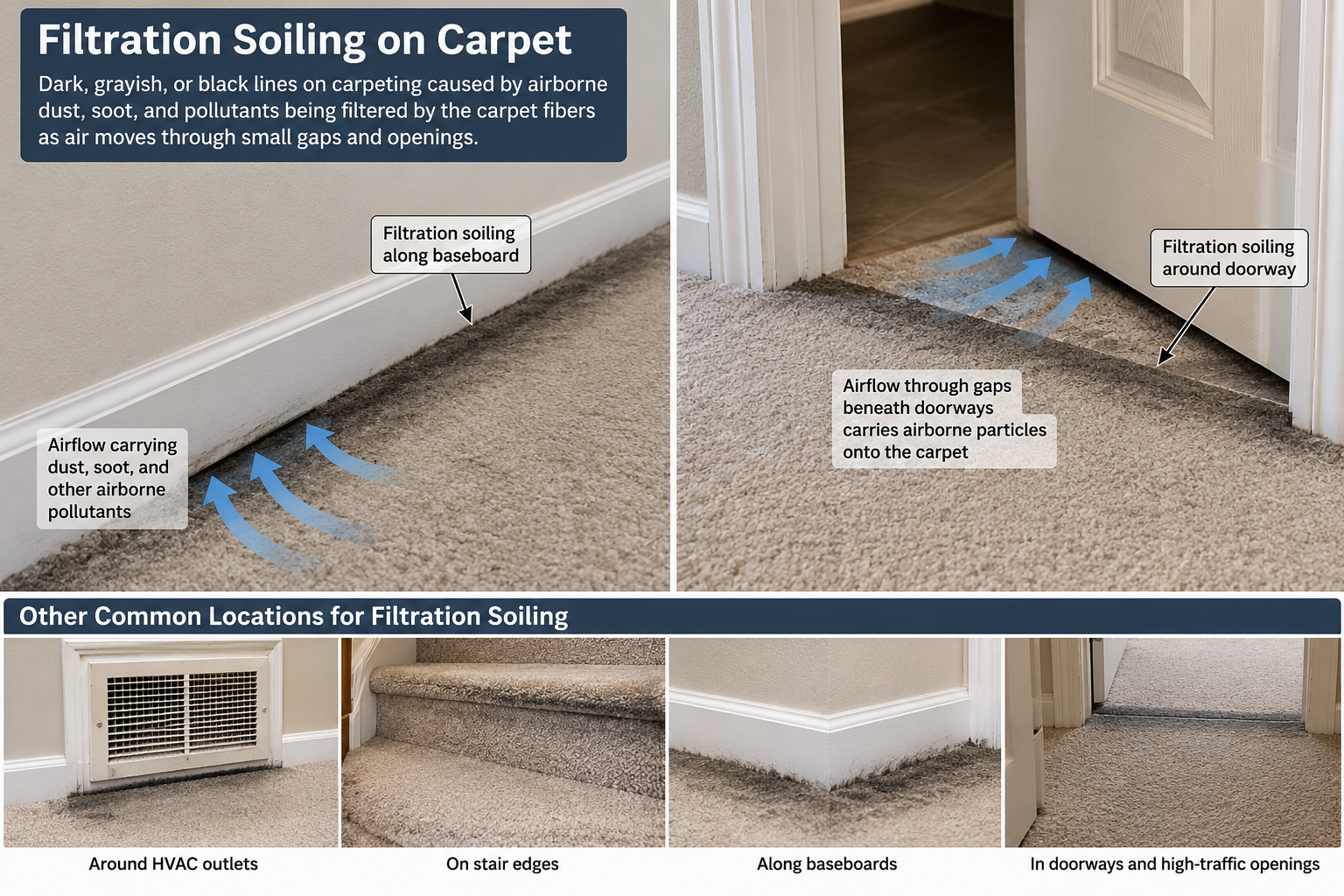
According to author Michael Hilton in The Carpet Buyer’s Handbook, filtration soiling is a term used to describe the dark, grayish, or black lines that sometimes appear on carpeting, particularly along walls, around HVAC outlets, baseboards, doorways, and stair edges.
Filtration soiling is not a carpet manufacturing defect. Rather, it occurs when dust, soot, and other airborne pollutants accumulate on carpet face fibers in areas where air flows across or through the carpet. This airflow often occurs through small gaps or openings beneath baseboards, around doorways, along stairways, or between sections of subflooring.
As air moves through these openings, the carpet acts as a filter, trapping fine airborne particles. Over time, these particles accumulate and create visible dark lines or streaks. Some of these contaminants contain oily or carbon-based particles that adhere strongly to carpet fibers, making them especially difficult to remove through conventional cleaning methods.
Filtration soiling can develop relatively quickly or accumulate gradually over months or years. Its severity depends on several factors, including the volume of airflow, the concentration and composition of airborne pollutants, and the length of time the contamination has been accumulating.
The condition is not necessarily related to the quality of the carpet, although it is generally more noticeable on lighter-colored carpeting than on darker-colored materials.
Common locations where filtration soiling may appear include:
- Along walls and baseboards
- Beneath closed doors
- Along the edges of carpeted stairways
- Around heating and air-conditioning vents
- At carpet seams or gaps between sections of subflooring
Air movement between floors, rooms, wall cavities, and other building spaces can contribute to this condition.
Because filtration soiling often involves extremely fine particles that become firmly attached to carpet fibers, specialized cleaning techniques and appropriate chemical solutions may be required. In severe cases, complete removal may not be possible.
Steps for Removing Filtration Soiling
Filtration soiling can be challenging to remove because the accumulated contaminants may contain oily residues, fine carbon particles, and other pollutants that are difficult to suspend and extract.
Some specialized filtration-soiling removers can effectively loosen these contaminants. However, improper application or inadequate rinsing of certain cleaning solutions may leave residues that contribute to rapid resoiling.
HydraMaster Natural Orange can be an effective solution for removing filtration soiling when properly applied, agitated, and thoroughly extracted. For particularly stubborn areas, HydraMaster SpotMaster Gel XP may provide additional cleaning assistance.
Recommended Cleaning Procedure
- Pretest the cleaning solutions.
Always pretest all cleaning solutions in an inconspicuous area to evaluate colorfastness, fiber compatibility, and any potential adverse reactions before proceeding.
- Protect adjacent walls and baseboards.
Place a protective shim or barrier between the carpet and the wall or baseboard to prevent cleaning solutions from contacting painted surfaces, woodwork, or other sensitive materials. A thin piece of plastic or another moisture-resistant material can provide an effective barrier.
- Prepare the cleaning solution.
Mix one part Natural Orange with 10 parts water in a trigger sprayer, flip-top spotting bottle, or handheld pump-up sprayer, provided this dilution is consistent with the product’s current label instructions.
For particularly severe filtration soiling, SpotMaster Gel XP may be applied to the affected carpet fibers according to its label directions.
- Apply the cleaning solution.
Apply Natural Orange evenly to the affected carpet fibers, concentrating on the areas where filtration soiling is most visible.
Use sufficient solution to contact the contaminated fibers without oversaturating the carpet backing, cushion, or adjacent surfaces.
- Observe appropriate safety precautions.
Avoid overspray and inhalation of spray mist. Follow the product’s Safety Data Sheet (SDS) recommendations regarding ventilation, handling, and appropriate personal protective equipment (PPE).
- Agitate the affected fibers.
Carefully work the cleaning solution into the affected carpet fibers using a spotting spatula or another appropriate agitation tool.
Use sufficient agitation to help loosen the accumulated contaminants while avoiding excessive mechanical action that could damage or distort the carpet fibers.
- Allow adequate dwell time.
Allow the cleaning solution to dwell for approximately 2–5 minutes, or as directed by the product label.
This contact time allows the cleaning agents to penetrate, loosen, and suspend the accumulated soils. Do not allow the cleaning solution to dry on the carpet.
- Thoroughly extract and rinse.
Extract the treated area using an appropriate hot water extraction tool and an acid/neutralizing rinse, such as HydraMaster ClearWater Rinse, when compatible with the cleaning chemistry and carpet.
Use the highest practical water temperature that is safe for the carpet fiber, backing, dyes, and installation.
Thorough rinsing and extraction are essential to remove suspended contaminants and minimize any residual cleaning agents that could contribute to resoiling.
- Evaluate the results and treat remaining discoloration.
Inspect the cleaned area after extraction.
If discoloration remains, determine whether it is caused by residual soil, permanent staining, or fiber discoloration.
Where appropriate and consistent with manufacturer instructions, HydraMaster KnockOut 1 may be applied to the affected area and allowed to dry according to its label directions.
Be aware that severe or long-standing filtration soiling may not be completely removable. Some discoloration may be permanent.
- Promote rapid drying.
For faster drying, particularly in humid environments, consider using an axial, centrifugal, or downdraft air mover after cleaning.
Ensure adequate ventilation and airflow to help reduce drying time and minimize the potential for moisture-related problems.
Preventing Filtration Soiling from Returning
While professional cleaning can significantly improve the appearance of filtration-soiled carpeting, the condition may return if the underlying airflow patterns and sources of airborne contamination are not addressed.
Homeowners and building managers should consider evaluating gaps beneath baseboards, around doorways, and between flooring components that may allow air to move through the carpet.
Proper HVAC maintenance, regular replacement of air filters, and reducing sources of airborne pollutants may also help minimize the accumulation of filtration soil.
Where appropriate, sealing identified air leakage pathways can help reduce recurring filtration soiling. Any sealing work should be performed using methods compatible with the building’s ventilation and HVAC requirements.
Remember: Successful filtration-soiling removal involves more than selecting the correct cleaning chemical. Proper agitation, adequate dwell time, thorough rinsing and extraction, and attention to the underlying airflow conditions all contribute to better, longer-lasting cleaning results.
For Professional Cleaning Solutions
To order Natural Orange, SpotMaster Gel XP, ClearWater Rinse, KnockOut 1, or other professional cleaning solutions, contact your local HydraMaster Distributor.
Find your nearest distributor at www.hydramaster.com/dealer-locator
Leave a Reply