The Benefits of Carpeting for Homes and Businesses
By Doyle Bloss
A great deal has been written and said in recent years about carpeting losing market share to hard surface flooring alternatives. Luxury vinyl plank (LVP), hardwood, laminate, tile, and stone have all gained popularity in residential and commercial environments. Along with this shift, questions about the cleanliness, maintenance requirements, and overall performance of carpeting continue to influence consumer perceptions.
We have all watched home improvement and real estate television programs where prospective homebuyers express concern about inheriting someone else’s carpeting. In many cases, the immediate reaction is to tear it out and replace it with a hard surface floor, regardless of the carpet’s actual condition or its potential for professional restoration.
Forward-thinking professional carpet cleaners have long recognized the importance of expanding their services beyond carpeting. The same technicians who once dragged their carpet cleaning hoses across tile, stone, hardwood, and resilient flooring now understand the opportunities associated with professionally cleaning and maintaining those surfaces.
The popularity of hard surface flooring has also helped create opportunities for the cleaning and maintenance of area rugs, Oriental rugs, and other specialty textiles. Successful cleaning professionals have expanded their technical knowledge, equipment capabilities, and marketing strategies to take advantage of these opportunities.
But none of these changes diminish the fact that carpeting remains an excellent floor covering with significant advantages.
In commercial environments, anyone who has been responsible for stripping, refinishing, and maintaining vinyl composition tile (VCT) understands that hard surface flooring is not necessarily easier or less expensive to maintain than carpeting. Every flooring material has its own maintenance requirements, challenges, and associated costs.
Advances in hot water extraction equipment, low-moisture encapsulation systems, agitation equipment, cleaning chemistry, and professional training have made carpet maintenance more efficient and effective than ever before.
As our industry continues to discuss the Carpet and Rug Institute’s Seal of Approval (SOA) program, cleaning standards, and the diversification of professional floor care services, we should not lose sight of the floor covering that helped build our industry.
For many of us, carpeting remains our first love.
Whether we agree or disagree with various industry initiatives, one thing is certain: The continued success of the professional carpet cleaning industry is closely connected to the health and vitality of the carpet manufacturing, retailing, and installation industries.
When properly evaluated, carpeting offers tremendous benefits that deserve to be promoted enthusiastically to homeowners, business owners, facility managers, and flooring retailers.
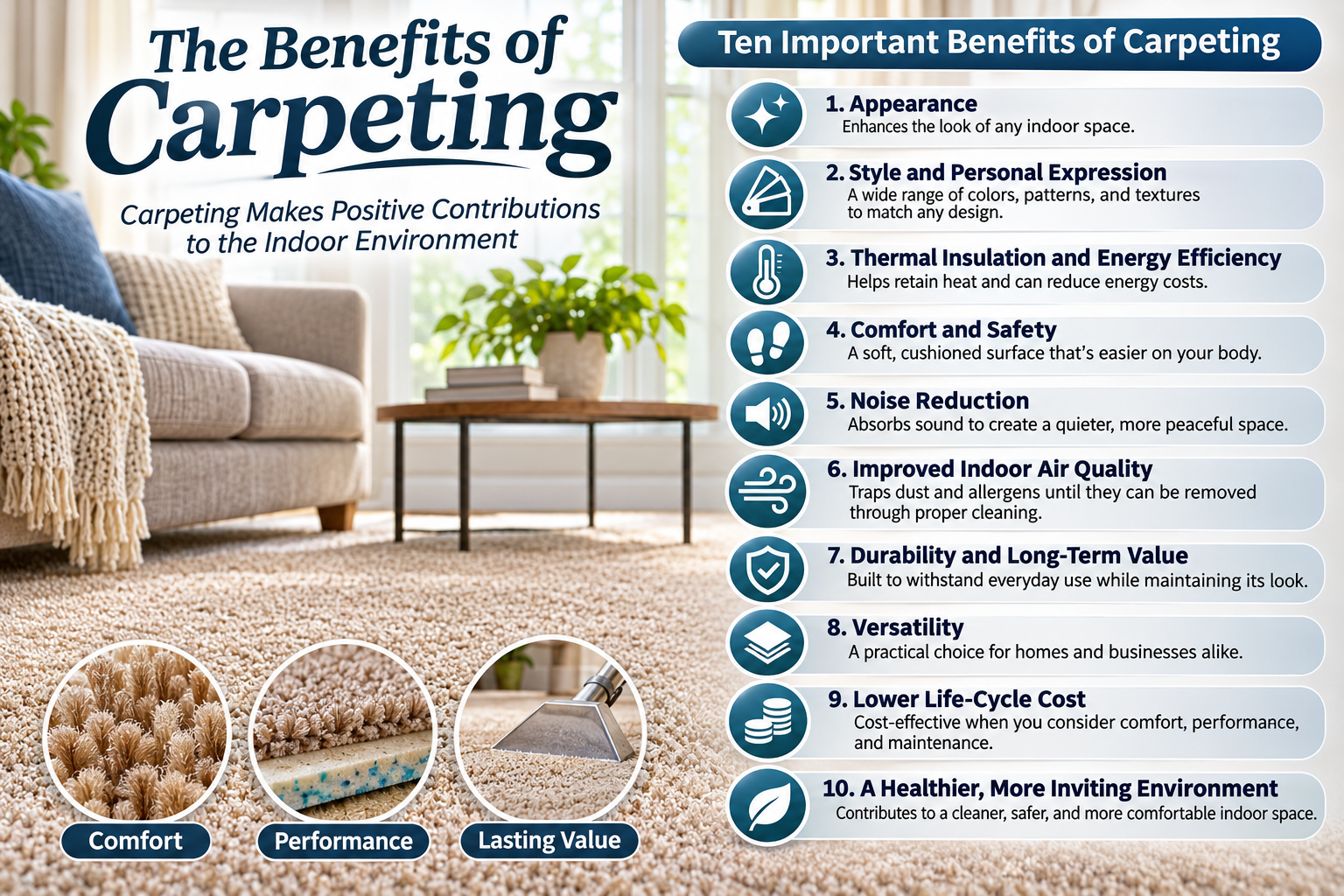
Ten Important Benefits of Carpeting
- Appearance
Carpeting enhances the appearance of almost any indoor environment. Through its wide variety of colors, patterns, textures, and pile heights, carpet can complement virtually any interior design.
It can create an atmosphere of warmth, sophistication, elegance, comfort, or casual relaxation, depending on the desired effect.
Unlike some flooring materials that become a dominant visual feature, carpeting can blend naturally into the overall design of a room, complementing furniture, wall coverings, lighting, and architectural details.
Carpeting provides tremendous flexibility in creating an attractive and inviting environment.
- Style and Personal Expression
Appearance is only one aspect of interior design. Carpeting also allows homeowners and businesses to express their individual styles and preferences.
Through variations in fiber type, yarn construction, denier, pile height, face weight, color, pattern, and texture, carpeting offers an extraordinary range of design possibilities.
From luxurious residential cut-pile carpets to sophisticated commercial patterned carpet tiles, carpeting can help establish the personality and character of an indoor space.
It allows individuals and businesses to make a design statement while maintaining comfort and functionality.
- Thermal Insulation and Energy Efficiency
Carpeting can contribute to the thermal insulation of an indoor environment.
The carpet pile, backing, and underlying cushion can provide resistance to heat transfer, helping reduce heat loss through the floor under certain conditions.
Anyone who has stepped out of bed on a cold winter morning and walked barefoot across a tile or hardwood floor understands the difference carpeting can make.
Carpet not only provides actual thermal insulation but also creates a perception of warmth because its surface generally feels warmer to the touch than many hard flooring materials under the same conditions.
Depending on the building design, carpet construction, cushion, and climate, these insulating properties may contribute to improved energy efficiency.
- Comfort Underfoot
Have you ever tried to curl up in front of a fireplace on a ceramic tile or hardwood floor?
Carpeting provides a level of softness and comfort that most hard surface flooring materials cannot duplicate without the addition of rugs or other cushioning.
Its resilient construction creates a more forgiving walking and standing surface, potentially reducing discomfort associated with prolonged periods on hard floors.
Carpeting also provides a comfortable surface for children playing, families relaxing, and people enjoying everyday activities.
The tactile comfort of carpeting contributes to a softer, warmer, and more welcoming indoor environment.
- Acoustics and Noise Reduction
Carpeting can make a significant contribution to controlling sound within an indoor environment.
Hard surface flooring reflects much of the sound generated by footsteps, conversations, moving furniture, and everyday activities. In rooms with extensive hard surfaces, these reflections can contribute to excessive reverberation and an uncomfortable acoustic environment.
Carpeting helps absorb sound energy, reduce reflected noise, and minimize the sound of foot traffic.
When installed over appropriate cushion or underlayment, it can also help reduce impact noise transmitted to spaces below.
These characteristics are particularly valuable in offices, hotels, schools, multifamily housing, and other environments where noise control is important.
A quieter environment can contribute to improved comfort, communication, concentration, and overall satisfaction with an indoor space.
- Safety and Cushioning
Carpeting can provide important safety advantages in residential and commercial environments.
Compared with many smooth hard surface floors, properly selected and maintained carpeting generally provides a more slip-resistant walking surface under typical dry conditions.
This can be particularly beneficial in areas where children, older adults, employees, and visitors are walking or moving frequently.
Carpeting also provides cushioning that may help reduce the severity of certain impacts when falls occur.
However, carpet selection, installation, transitions, pile characteristics, and maintenance all influence safety. Wrinkles, loose edges, uneven transitions, and poorly maintained carpet can create trip hazards.
Properly specified, installed, and maintained carpeting can contribute to a safer and more comfortable walking environment.
- Professional Image and Atmosphere
Carpeting can help establish the image and atmosphere that a homeowner or business wants to project.
In a professional office, carpeting may communicate warmth, stability, sophistication, and attention to detail.
In hotels, restaurants, conference facilities, and other commercial settings, carpeting can help create an inviting and comfortable atmosphere.
Carpet color, pattern, and texture can also reinforce corporate branding and interior design objectives.
The appearance and condition of carpeting influence how visitors, customers, and employees perceive the overall quality and maintenance of a facility.
Clean, attractive carpeting makes a positive statement about the people responsible for maintaining the indoor environment.
- Soil Concealment and Appearance Retention
One often-overlooked advantage of carpeting is its ability to conceal certain types of soil between routine cleaning procedures.
The three-dimensional construction of carpet pile, combined with variations in color, pattern, texture, and fiber characteristics, can make some tracked-in soil and minor spots less immediately visible than they would be on smooth hard surface flooring.
On many hard floors, dust, footprints, debris, and liquid spills become readily apparent and may require frequent attention to maintain an acceptable appearance.
Carpeting can often maintain an attractive appearance between scheduled maintenance procedures.
However, it is important to distinguish soil concealment from actual cleanliness.
Just because soil is not readily visible does not mean it is absent.
Dry particulate soil can accumulate within carpet pile and, when subjected to foot traffic, contribute to fiber abrasion, appearance deterioration, and premature wear.
For this reason, an effective maintenance program must include regular vacuuming, prompt spot removal, and periodic professional cleaning.
Carpet’s ability to conceal soil is an appearance advantage, but it should never become an excuse for inadequate maintenance.
- Cleanability and Long-Term Maintenance
One of the most frustrating misconceptions professional carpet cleaners encounter is the belief that carpeting is inherently more difficult or expensive to maintain than hard surface flooring.
The reality is that every flooring material requires appropriate maintenance.
Hardwood flooring may require specialized cleaning procedures and periodic refinishing. Natural stone may require specialized cleaning, sealing, or restoration. Tile and grout can accumulate difficult-to-remove soil, while certain resilient flooring materials require periodic restorative maintenance.
Carpeting also has specific maintenance requirements, but modern equipment, chemistry, systems, and technician training make effective carpet cleaning readily achievable.
A comprehensive carpet maintenance program can include:
- Routine maintenance: Frequent vacuuming with properly maintained equipment to remove dry particulate soil before it becomes deeply embedded in the carpet pile.
- Spot and spill management: Prompt identification and treatment of spots and spills using appropriate procedures and chemistry.
- Interim appearance maintenance: Low-moisture encapsulation and other suitable methods to help maintain appearance and control soil accumulation between restorative cleanings.
- Periodic restorative cleaning: Professional hot water extraction or other manufacturer-approved procedures to remove accumulated soil, cleaning residues, and contaminants from the carpet.
Hot water extraction, particularly when performed using properly maintained professional equipment and appropriate cleaning chemistry, can be an effective restorative cleaning method.
Truckmounted extraction equipment can provide substantial cleaning and recovery capabilities, although successful cleaning ultimately depends on the complete system, technician procedures, carpet construction, and site conditions.
A properly designed maintenance program can help extend carpet service life, preserve appearance, and maintain the flooring investment.
When evaluated over the useful life of the floor covering, carpeting can be a practical and economical choice in many residential and commercial applications.
- Particle Capture and Contributions to Indoor Environmental Quality
One of the most interesting and frequently misunderstood characteristics of carpeting is its ability to capture and retain particulate matter.
Carpet pile creates a three-dimensional surface that can collect dust, tracked-in soil, allergens, and other particles that settle from the indoor environment.
Unlike smooth hard surface flooring, where deposited particles may be more readily disturbed and redistributed by normal activity, carpeting can retain some of these particles within its pile structure until they are removed through effective cleaning.
This characteristic has led to carpeting sometimes being described as a passive collection surface for airborne particulate matter.
However, it is important to understand that carpeting is not a substitute for an effective HVAC filtration system, nor does it automatically improve indoor air quality simply by capturing particles.
Carpet can also accumulate allergens, biological contaminants, and other unwanted materials. Depending on conditions, some of these particles can be released back into the air through foot traffic and other disturbances.
The key is proper maintenance.
Frequent vacuuming using suitable equipment with effective filtration can remove accumulated particulate soil. Periodic professional deep cleaning can provide additional removal of embedded soil and other contaminants.
Moisture control and thorough drying are also essential to preventing microbial growth and maintaining a healthy indoor environment.
When carpeting is appropriately selected, installed, and maintained, its particle-retention characteristics can be part of an effective overall indoor environmental quality strategy.
The important message is not that carpet magically eliminates pollutants. Rather, carpet provides a surface from which accumulated soil and particles can be systematically removed through an effective maintenance program.
Have We Forgotten Why People Buy Carpet?
One could argue that the carpet manufacturing industry has contributed to some of its own marketing challenges by creating unrealistic consumer expectations about stain resistance, soil resistance, and long-term appearance retention.
For years, manufacturers competed aggressively to promote increasingly sophisticated stain-resistant technologies and extended warranties.
Marketing campaigns frequently showed seemingly impossible spills being removed effortlessly with a sponge or paper towel.
While stain-resistant technologies have provided genuine performance improvements, some of these messages may have led consumers to expect carpeting to resist virtually every stain and remain attractive with minimal maintenance.
Professional carpet cleaners understand that no carpet is completely stainproof, soilproof, or maintenance-free.
The performance of carpeting depends on numerous factors, including fiber type, construction, dyeing method, protective treatments, installation, environmental conditions, and maintenance practices.
Perhaps, in the industry’s enthusiasm to promote stain resistance and technological advancements, we sometimes overlooked the fundamental reasons consumers choose carpeting in the first place.
Color. Style. Comfort. Warmth. Softness. Quietness.
These are powerful emotional and practical motivations that continue to influence flooring decisions.
Years ago, the Carpet and Rug Institute promoted the memorable message:
“Carpet — It Just Feels Better.”
That simple statement communicated something important about carpeting that technical specifications and warranty comparisons often fail to capture.
People do not purchase carpeting solely because of its stain-resistant properties or its expected service life.
They purchase it because of how it looks, how it feels, and how it contributes to the atmosphere of their home or business.
Today’s carpet manufacturers and retailers have an opportunity to reinforce these fundamental benefits while continuing to educate consumers about improvements in carpet performance and the importance of proper maintenance.
The Carpet Industry Value Chain
Many years ago, industry friend and veteran Bill Doan, who worked with the STAINMASTER division of DuPont, used the phrase “The Carpet Industry Value Chain.”
The concept remains just as relevant today.
The success of carpeting depends on the collective efforts of numerous interconnected segments of our industry.
Carpet fiber producers, manufacturers, distributors, retailers, installers, professional cleaners, and consumers all play important roles.
When any part of that value chain fails to meet expectations, the entire industry can be affected.
Consider what happens when a consumer purchases carpeting based on unrealistic expectations, receives inadequate maintenance information, and subsequently experiences appearance deterioration or permanent staining.
The consumer may conclude that carpeting itself is the problem.
In reality, the issue may involve improper product selection, installation, maintenance procedures, unrealistic expectations, or a combination of factors.
Professional carpet cleaners have an important opportunity to strengthen this value chain by helping consumers understand how to properly care for their flooring investment.
We can also work more closely with flooring retailers, installers, designers, and facility managers to communicate realistic expectations and establish appropriate maintenance programs.
A carpet sale should not represent the end of the relationship with the customer.
It should represent the beginning of a long-term commitment to helping that customer receive maximum value, appearance retention, and service life from the flooring investment.
Professional Carpet Cleaners Should Be Carpet’s Strongest Advocates
As professional cleaners, we have wisely expanded our services to include tile, stone, hardwood, luxury vinyl plank, area rugs, and other floor coverings.
These services provide valuable business opportunities and allow us to better serve our customers.
But expanding our capabilities should not mean abandoning our commitment to carpeting.
For many professional cleaners, carpeting remains the foundation upon which their businesses were built.
And when properly selected, installed, and maintained, carpeting continues to offer an exceptional combination of appearance, comfort, warmth, acoustical performance, and long-term value.
We should be sharing that message with homeowners, business owners, property managers, designers, and especially flooring retailers.
Perhaps we need to do a little “preaching to the choir” by reminding carpet retailers of the important benefits their products provide and demonstrating how professional maintenance can help their customers protect their investments.
Professional carpet cleaners should not simply be the people called when carpeting becomes visibly dirty.
We should be recognized as essential partners in protecting the appearance, performance, and service life of carpeting throughout its useful life.
By working together, the carpet manufacturing, retailing, installation, and professional cleaning industries can help consumers make informed flooring decisions and appreciate the genuine advantages that carpeting continues to offer.
And while I fully recognize the value of hard surface flooring and the business opportunities associated with cleaning it, carpeting remains the floor covering of choice in my own home.
The reasons are the same ones we have discussed throughout this article.
It looks good. It feels good. It provides comfort, warmth, and quietness. And with proper professional maintenance, it can continue to perform beautifully for years.
Carpeting makes positive contributions to the indoor environment. That is a message worth sharing — and one our entire industry should be proud to promote.
Leave a Reply